


Symptoms, heart rate on standing, flare triggers, salt and fluids, and what a wearable can and cannot tell you. Written plainly, without the diagnosis talk you did not ask for.
UNDERSTANDING THE CONDITION
What is POTS?
POTS, or postural orthostatic tachycardia syndrome, is a disorder of the autonomic nervous system in which symptoms appear when you are upright and ease when you lie down.
The autonomic nervous system runs heart rate, blood flow, digestion, and temperature without asking your permission. In POTS, the adjustment your body makes when you stand up does not work the way it should, and heart rate climbs to compensate.
The Cleveland Clinic estimates more than 500,000 people in the United States are affected, most commonly women between 15 and 50, though men have it too.
What are the symptoms of POTS?
Symptoms cluster around being upright, and they extend well beyond a fast heart rate.
Commonly described experiences include:
- Lightheadedness or dizziness on standing
- A racing or pounding heartbeat when upright
- Fatigue that rest does not fully resolve
- Brain fog and difficulty concentrating
- Nausea and digestive discomfort
- Shakiness, sweating, or temperature sensitivity
- Headaches and poor sleep
Most people notice the pattern long before they find the name for it. It is usually the tenth episode, not the first, that sends someone searching.
How much does heart rate rise on standing with POTS?
Johns Hopkins Medicine describes the defining feature as a heart rate increase of at least 30 beats per minute in adults, or 40 beats per minute in adolescents, within the first ten minutes of standing, alongside symptoms.
The number alone is not the whole picture. The rise has to occur with symptoms, and other explanations have to be ruled out first. That assessment belongs to a clinician, not to an app or a wearable.
Can you have POTS with normal blood pressure?
Yes. A blood pressure reading that looks unremarkable does not rule POTS out.
Part of how POTS is distinguished clinically is by ruling out orthostatic hypotension, which is a significant blood pressure drop on standing. So a person can have steady blood pressure while their heart rate is doing something entirely different. A normal reading is not a closed door.
How is POTS diagnosed, and what is a tilt table test?
Diagnosis involves measuring heart rate and blood pressure in different positions, often using a tilt table test, and excluding other causes.
In a tilt table test you lie on a table that slowly rotates you toward upright while sensors track heart rate and blood pressure. The point is to reproduce, under observation, the thing that keeps happening to you in the shower and in the grocery line. A standing test may be used instead. Blood work and heart rhythm monitoring often come along with it.
Which doctor treats POTS?
There is no single specialty. Primary care, cardiology, and neurology all see POTS, and some post-COVID clinics do as well.
Finding a clinician familiar with autonomic conditions tends to matter more than the specialty on the door. Patient organizations such as Dysautonomia International and Standing Up to POTS maintain resources that many people use as a starting point.
CAUSES AND ASSOCIATIONS
What causes POTS?
Researchers do not yet know exactly what causes POTS, and there are likely several different routes to it.
The National Institute of Neurological Disorders and Stroke states plainly that the cause is not fully understood. Onset is often described as following a viral illness, an injury, surgery, pregnancy, or a period of prolonged bed rest. That is a hard answer to sit with when you were hoping for a reason.
Can COVID cause POTS?
There is a documented association between COVID-19 infection and subsequent POTS diagnoses, and a portion of people with long COVID appear to be dealing with POTS specifically.
This has become one of the highest-volume POTS searches on the internet, and interest in the connection grew sharply after 2020. The mechanisms are still being studied.
Is POTS linked to hypermobility, EDS, or mast cell disorders?
There is a recognized overlap between POTS, joint hypermobility disorders including hypermobile Ehlers-Danlos syndrome, and mast cell disorders.
Plenty of people arrive at one diagnosis and find the other two waiting behind it. If you are being assessed for one, the others are reasonable to raise.
Is POTS just anxiety?
No. POTS involves the autonomic nervous system, and it is a distinct condition from an anxiety disorder.
Almost everyone in this community has been asked some version of this question. A racing heart, breathlessness, and a flooded nervous system look similar from the outside no matter what set them off, which is why the two get confused.
Living in an unpredictable body can absolutely produce anxiety. That is a consequence worth taking seriously in its own right, and it is not the same as being the explanation.
DAILY PATTERNS AND FLARES
Why do POTS symptoms get worse after eating?
Digestion draws blood flow toward the gut, which can leave less available elsewhere. Many people describe larger meals, and meals high in refined carbohydrates, as harder days.
How much this affects you, after which meals, and at what size, varies from person to person. That specificity is the part no article can supply. It is the part you have to observe in your own days.
Worth logging: meal size, time of day, and how long after eating the change showed up. Three weeks of that is more useful to a clinician than a general description of feeling worse after food.
Why is showering so exhausting with POTS?
A shower combines heat, standing still, and arms raised above the head. Each of those is commonly described as demanding, and a shower stacks all three.
This is one of the most relatable questions in the whole POTS search landscape, and one of the least covered. Many people adapt by changing water temperature, using a shower stool, or timing showers for their better hours.
Why is POTS worse in heat, in the morning, or before a period?
Heat, dehydration overnight, and hormonal changes across the menstrual cycle are all commonly reported as harder conditions.
Mornings come up repeatedly, as do hot weather, hot rooms, and hot showers. Many people track their cycle alongside symptoms because the pattern is often noticeable to them even when it is not visible in a single appointment.
What triggers a POTS flare, and how long does it last?
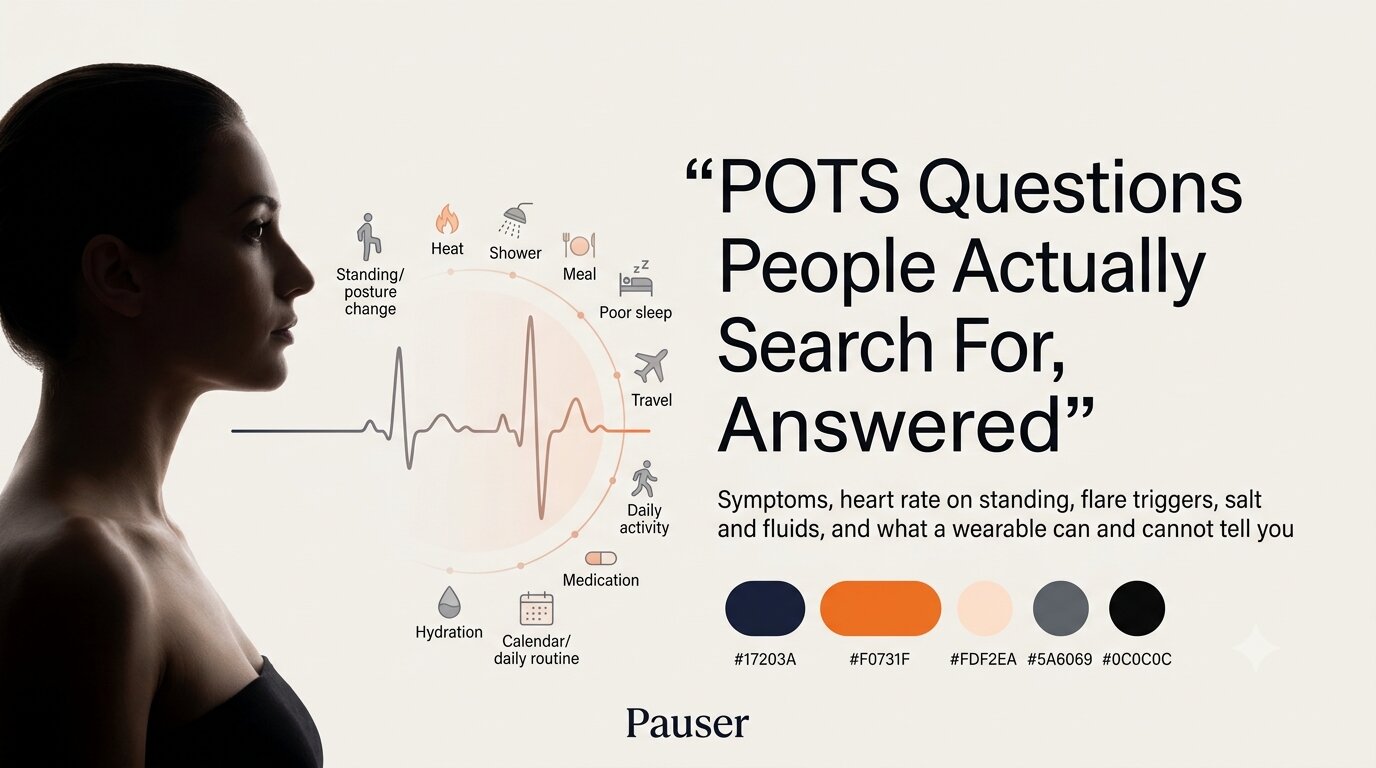
Triggers are personal. Frequently described ones include heat, large meals, standing still, poor sleep, illness, stress, dehydration, and overexertion the day before.
Flare length varies widely, from hours to weeks. Because both triggers and duration are individual, general lists only get you so far. The useful version is your list, built from your days.
This is the gap Pauser was built for. Pauser reads heart rate from your wearable in the background and notifies you when it moves outside a range you set. When it does, you tag what was happening. Meal. Shower. Meeting. Heat. Poor sleep. Over weeks that becomes a history you can look back through and compare.
It does not tell you why something happened. It keeps the record, so you are not relying on memory three weeks later when someone asks how often this actually occurs.
LIVING WITH IT
What helps POTS without medication?
Non-drug approaches commonly discussed include fluid and salt intake, compression garments, changing position gradually, and carefully graded activity.
Amounts and specifics vary by person and by whatever else is going on, including blood pressure and kidney health, which is why you will not find numbers here. These are conversations to have with your clinician rather than assemble from strangers online.
Pacing note: for many people in this community, energy is limited and unevenly distributed. Approaches that demand daily consistency often cost more than they return. Rest is not a failed day.
How do I explain POTS to my employer, school, or family?
Concrete patterns communicate better than adjectives. Specific and repeatable beats general and invisible.
This is not a medical question at all. It is a translation problem: turning an invisible, variable, unphotographable condition into something a scheduling manager will act on.
"I need twenty minutes seated after meals" lands differently than "I get tired sometimes." A written record of when and how often something happens gives you specifics to point to, which is often what converts a conversation into an accommodation.
OUTLOOK
Does POTS go away?
There is no cure, and outcomes vary widely from person to person.
Some people improve substantially with management. Some fluctuate for years. Some describe themselves as recovered. Nobody can give you your version of that answer in advance, and anyone online offering to should be read carefully.
Is POTS a disability?
It depends on severity and on the rules where you live, not on the diagnosis alone.
POTS affects people very differently. Some manage full-time work with adjustments. Others are substantially limited. Whether a given case meets a legal or workplace definition is a question for the relevant authority in your country, and documentation of the day-to-day impact usually matters more than the label.
WEARABLES AND TRACKING
Can an Apple Watch detect POTS?
No. No consumer wearable diagnoses POTS. Anything claiming otherwise should be treated with caution.
What a wearable can do is notice. Heart rate data is continuous and it does not forget. The limitation is that a number without a context is close to useless. Knowing your heart rate reached 128 does not help. Knowing it reached 128 four minutes after standing up from lunch, for the fourth Tuesday running, is a different kind of information.
How do I track what is happening to show my doctor?
Pair the number with the moment. A heart rate reading becomes useful when it carries the context of what you were doing.
Pauser connects your wearable data to what was actually going on. On iPhone it works with Apple Health and Apple Watch. On Android it works with Health Connect, including Garmin, Wear OS, and Samsung devices.
You set your own range. When your heart rate crosses it you get a Pause Signal, tag what was happening, and take a short guided breathing pause if you want one. There is also a Monitor Session, a sit-and-stand observation you can run yourself and keep a record of. It is a self-tracking tool, not a clinical test, and not a substitute for one. You can export your history to bring to an appointment.
No streaks. No shame. No daily pressure to perform wellness for an app.
Your watch tracks a number. Pauser explains the story.
Build a record of your own patterns, in your own words, from the days you actually lived. Available on iOS and Android at pauser.health