



Yoga does something quiet and real to your body. Here is what happens on the mat, and how to actually notice it.
Most people come to yoga for a feeling. The calm afterward. The sense of having landed back in your own body after a long day of being everywhere but there.
That feeling is real, and it is not vague or mystical. A lot of it comes down to what yoga asks of your nervous system, the quiet internal system that runs your heart rate, your breathing, and your sense of being wound up or at ease. Yoga gives that system a chance to shift gears.
The interesting part is that you can see some of it. Your heart rate tells a small story every time you practice, and that story is often more useful than the number itself. Let's walk through what yoga is doing under the surface, and how you can start to notice it.
In this article
What Yoga Asks of Your Nervous System
Your nervous system has two broad modes. One is the geared-up mode, the one that handles stress, urgency, and go. The other is the settling mode, the one that helps you rest, digest, and recover. Modern life leans hard on the first one. Many of us spend the day slightly braced without even noticing.
Yoga, especially slower and breath-led styles, invites the settling mode forward. Long exhales, held gentle poses, and steady attention on the body all nudge you toward that quieter gear. That is a big part of why you often feel looser and clearer afterward. You gave your system permission to stand down for a while.
None of this is a cure for anything, and yoga is not a treatment. It is simply a practice that many people find helps them feel calmer and more at home in their bodies. That is reason enough.
What Happens to Your Heart Rate on the Mat
Here is where it gets genuinely interesting, because yoga is not one thing, and your heart rate reflects that.
In a flowing, more active practice, your heart rate rises. You are moving, holding, balancing, and working, and your body responds the way it should. That is not a failure to relax. That is the practice doing its job.
In a slower or restorative practice, and especially during breathing and the stillness at the end, your heart rate often drifts downward. Those long exhales and quiet holds are where a lot of the settling shows up. If you have ever felt your whole body sink into the floor during the final resting pose, that shift has a physical side to it.
So a single yoga session can hold both. A gentle climb through the active part, and a soft settling through the calm part. The number on your wrist is not the point. The shape of it across the session is the story.
The Catch: You Cannot Feel It Clearly in the Moment
The trouble is that the mat is the one place you are trying not to analyze anything.
You are supposed to be present, not checking your pulse. And that is exactly right. But it means the useful information, how your body actually responded, slips past you. You finish, you feel good, and by the evening you could not tell someone whether that particular class settled you more than usual or less.
Over weeks, this is how the most helpful question goes unanswered. Which kind of practice actually calms your body the most? A fast flow or a slow one? Morning or evening? A long session or a short one? You have a general sense, but general senses are easy to get wrong, and easy to forget.
How Pauser Helps You See It
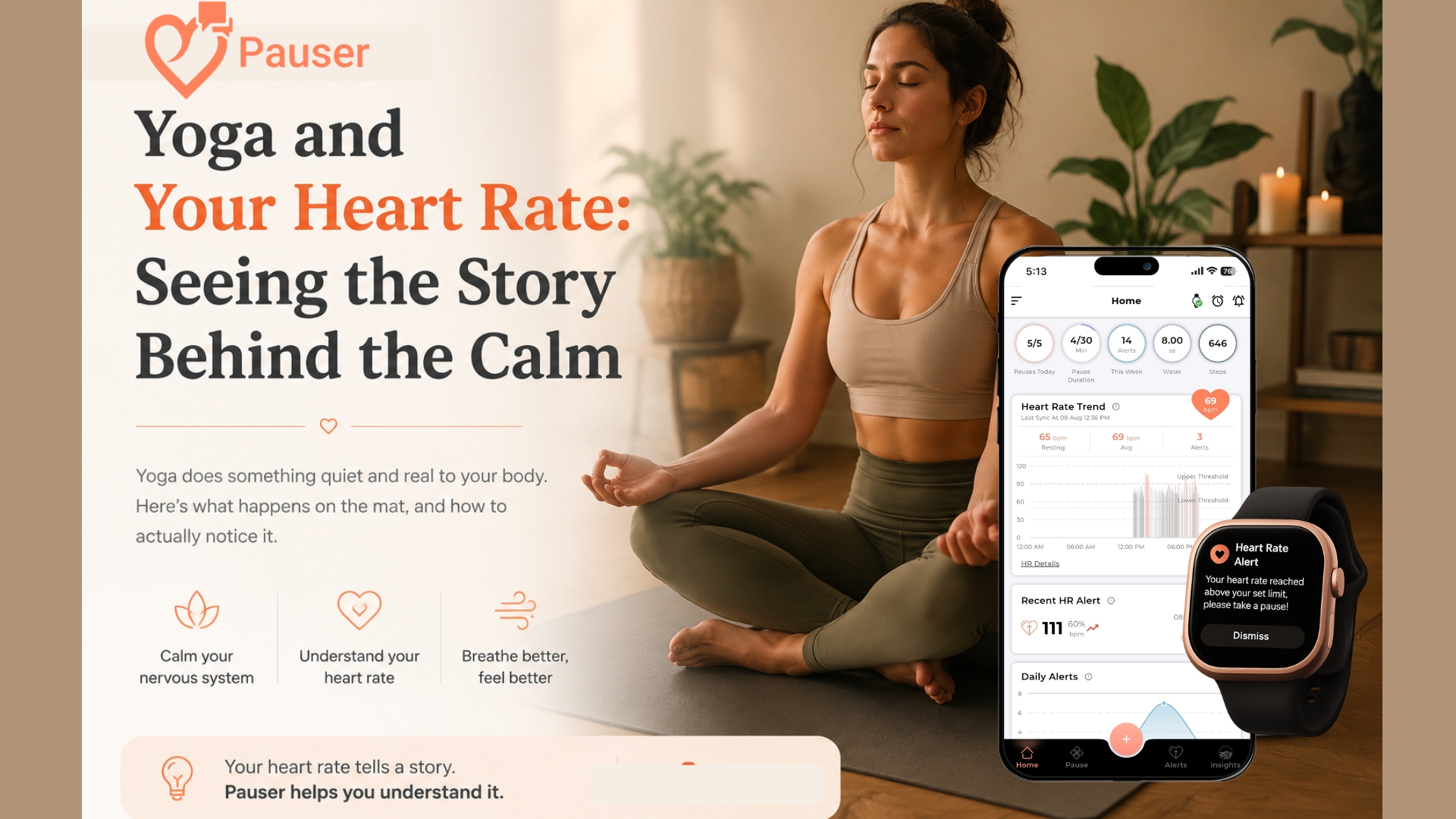
Your watch tracks a number. Pauser explains the story.
First, to be clear about what Pauser is and is not. Pauser does not teach yoga. There are no poses, no classes, and no guided flows inside the app. You bring your own practice, whether that is a class, a video, or your own quiet sequence at home. Pauser is simply the tool alongside it.
Here is how that works. You start a monitoring session and label it as yoga, then you practice as you normally would. Pauser follows your heart rate through the whole thing, so afterward you can see the shape of the session laid out in front of you. The climb through the active part. The settling through the calm part. Where your body wound up, and where it let go.
A few ways that turns into something useful:
- See the settling, not just guess at it. Instead of a vague sense that class was relaxing, you can look back at how your heart rate eased through the calm parts of your practice.
- Compare your practices. Over time you can notice whether slow restorative sessions settle you more than fast flows, or whether evening practice lands differently than morning.
- Connect it to your day. Because Pauser also lets you note how you felt and what else was going on, you can start to see how a hard day and a good practice fit together.
Pauser also has its own breathing exercises and a pause feature, separate from any yoga you do. When you want a reset on an ordinary day, not just on the mat, those give you a short, guided way to come back down.
None of this asks you to analyze anything while you practice. You stay present. Pauser just holds the details for you, so the story is waiting when you are ready to look.
Finding the Yoga That Actually Calms You
The real payoff of seeing your practice is that it stops being generic advice and starts being about you.
Someone might tell you that slow yoga is more calming than fast yoga. For most people that holds. But you are not most people, you are you, and the only way to know what settles your particular body is to notice it happening more than once. Maybe a gentle morning flow leaves you steadier than a slow evening class. Maybe short and frequent works better for you than long and occasional. When you can see the pattern instead of guessing at it, you can lean into the practice that actually gives you what you came for.
A Gentle Note If Your Body Is Sensitive
If you live with something like POTS, dysautonomia, long COVID, or ongoing fatigue, yoga can still have a lot to offer, but the standing and upright styles may not be the right starting point. Gentle, reclined, and restorative practices are often kinder to a sensitive system, and slow breathing can be its own quiet practice on a hard day.
The most important rule is to listen to your own body and move at its pace, not the pace of a video or a class. Rest is not cheating. Seeing how your heart rate responds to a gentle practice can also help you learn what your body can comfortably take on a given day, so you can pace yourself with a little more confidence. As always, if you have a health condition, talk with your own healthcare professional about what kind of movement is right for you.
How to Start
Keep it small and kind.
Pick one short practice you already enjoy, or a simple gentle sequence if you are new. Start a monitoring session, then forget about it and just practice. Afterward, take a look at the shape of your heart rate and notice where it settled. Jot down how you felt.
Do that a handful of times across a couple of weeks, with different styles or times of day, and you will start to see your own pattern emerge. Not a rule from an article, but the real answer for your body.
Common Questions
Does yoga lower your heart rate?
It depends on the style. Active, flowing yoga raises your heart rate while you move, which is completely normal. Slower and restorative yoga, along with breathing and the final rest, is where many people notice their heart rate settling. A single session can include both.
Does Pauser include yoga classes or poses?
No. Pauser does not teach yoga and has no poses, classes, or guided flows. You do your own practice however you like, and Pauser works alongside it by following your heart rate when you run a session. It also has its own breathing exercises and a pause feature for calming down on any day.
Do I need a smartwatch to get value from yoga?
Not at all. Yoga is worth doing for its own sake, watch or no watch. A wearable simply lets you see some of what is happening, which can help you understand which practices settle you most. Pauser works with an Apple Watch on iPhone, and with Garmin or Wear OS watches on Android.
Should I be checking my heart rate during class?
No, and please do not. The whole point of practice is to be present. Let a monitoring session hold the details in the background, and look at the story afterward when you are ready.
Can yoga help with stress?
Many people find that yoga helps them feel calmer and more settled, which is one of the most common reasons people practice. It is a wellness practice, not a medical treatment, so think of it as a way to support how you feel rather than a fix for a condition.
What kind of yoga is most calming?
Generally the slower, breath-led, and restorative styles. But the honest answer is that it varies from person to person, which is exactly why it helps to notice how your own body responds over a few sessions rather than assuming.
The Takeaway
Yoga gives your nervous system a chance to shift out of go and into settle, and your heart rate quietly reflects that shift every time you practice. You do not have to watch it happen. You just have to be able to look back and see it.
That is the small, useful thing Pauser adds to a practice you already love. Not another number to chase, but the story behind the number, so the calm you feel makes a little more sense, and you can find more of it.
Pauser helps you connect what your wearable is picking up with what is actually happening in your life, so patterns like these get easier to see over time.
Your watch tracks a number. Pauser explains the story.
Find your why. Take a pause.
This article is for education and general wellness only. It is not medical advice, and Pauser is not a medical device. It does not diagnose, treat, or cure any condition. If you have a health condition, please talk to a qualified healthcare professional before starting a new movement practice.
Tags: Heart Rate, Pauser