



Why Your Brain May Benefit From Both Physical Training and Mindfulness
For years, wellness advice has often presented physical exercise and mindfulness as two different ways to manage stress and support mental performance. Do you sweat out your stress, or sit quietly and breathe through it?
Neuroscience suggests that this may be the wrong way to frame the choice. Exercise and mindfulness influence the brain and body through different mechanisms, and they can complement one another. Physical activity can support brain health and adaptability, while mindfulness can help us develop greater awareness of our thoughts, attention and responses.
The Neuroplasticity Question: More Is Not Always Better
Aerobic exercise is associated with changes in neuroplasticity, the brain's ability to adapt by changing its connections and functioning. Research has linked exercise with biological processes that support brain health, including changes involving brain-derived neurotrophic factor (BDNF). These processes are one reason physical activity is widely studied for its potential cognitive and neurological benefits.
But neuroplasticity itself is not inherently positive or negative. It describes the brain's capacity to adapt. What matters is how that capacity interacts with learning, behavior, environment and repeated experience. This is why exercise should not be viewed simply as a way to 'rewire' the brain in a predetermined direction.
Key takeaway: Exercise can create conditions that support brain adaptability, but that does not mean every change will automatically lead to better focus, calmer emotions or healthier habits.
Meditation and Mindfulness: Training Attention and Awareness
Mindfulness takes a different approach. Rather than primarily challenging the body through physical exertion, mindfulness practices train attention and awareness. With regular practice, people may become better at noticing thoughts, emotions and physical sensations without immediately reacting to them.
Research has explored whether mindfulness practice is associated with changes in brain regions involved in attention, emotional regulation and self-awareness. Some studies have reported changes in areas such as the amygdala and regions of the prefrontal cortex, although findings vary and should not be interpreted as proof that meditation produces the same structural changes in everyone.
Why Exercise and Mindfulness Can Work Well Together
The strongest takeaway may not be that one approach is better than the other. It is that they serve different purposes.
Exercise supports the body and brain. Physical activity can support cardiovascular health, brain health and the biological processes involved in adaptation and learning.
Mindfulness supports awareness. Mindfulness can help people notice thoughts, emotions and physical sensations and respond to them more intentionally.
Together, they can support self-regulation. Using movement and mindfulness as complementary practices can create opportunities to notice how your body responds to activity, stress, rest and everyday experiences.
The Bigger Picture: From Signals to Self-Awareness
Our bodies are constantly responding to what we do and what happens around us. A demanding workout, a stressful conversation, a poor night's sleep, a crowded commute or a quiet moment of recovery can all become part of that experience.
The important question is not always whether a particular number went up or down. It is also what was happening around that change. When we combine physiological signals with everyday context, we can begin to build a more complete picture of how our body responds to life.
When to Work Out and When to Pause
There is no universal formula for when someone should exercise or meditate. The right approach depends on the individual, their goals and how they are feeling in the moment.
Some days may call for movement. Other days may call for recovery, breathing or a few quiet minutes of mindfulness. The goal is not to choose one over the other. It is to become more aware of what your body and mind may need.
The Takeaway
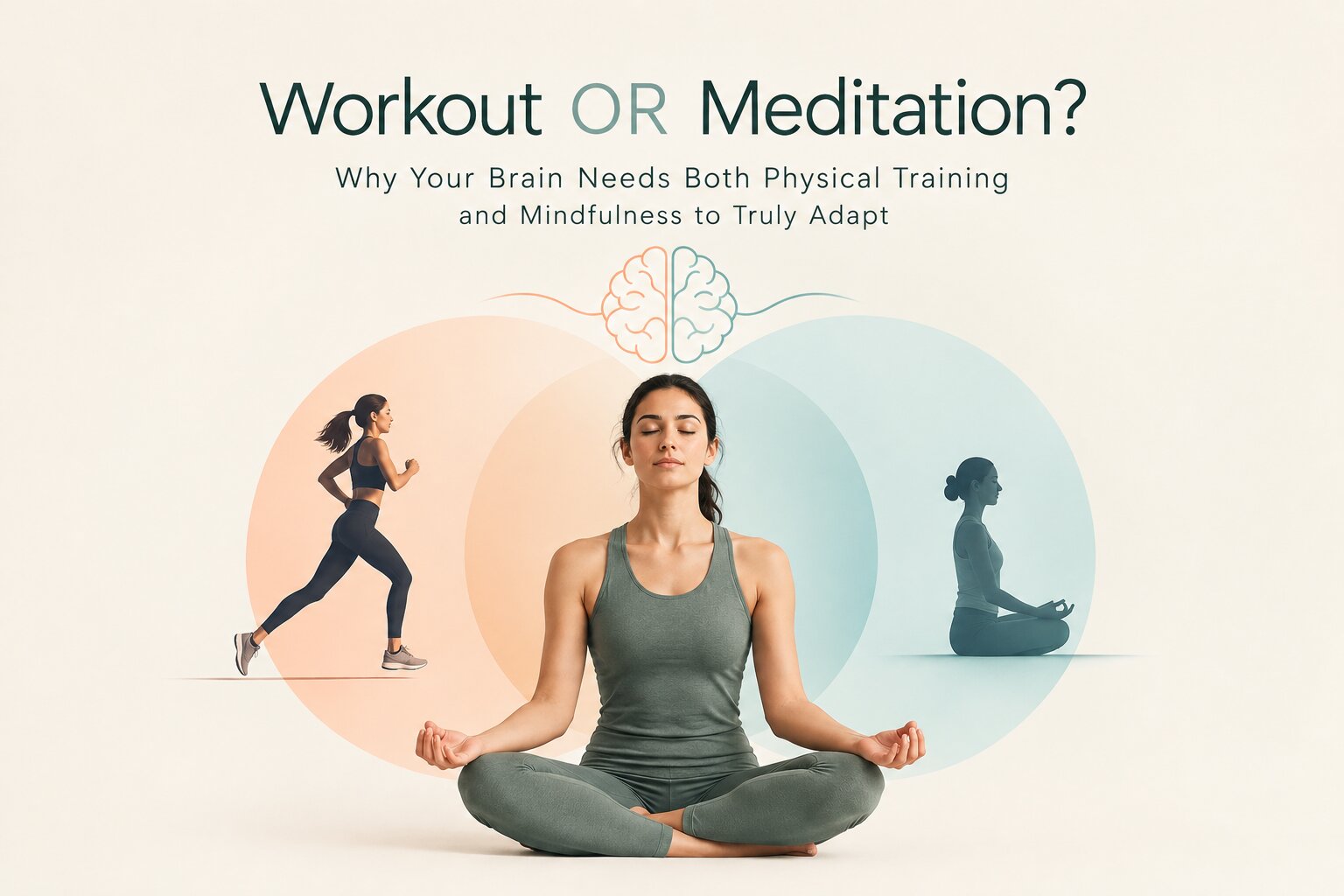
Workout or meditation? It does not have to be an either-or decision.
Exercise and mindfulness work through different pathways, but both can contribute to a healthier relationship with stress, attention and recovery. Exercise can support the body's capacity to adapt, while mindfulness can help us become more aware of our internal experience and our responses to it.
The goal is not just to train harder or pause longer. It is to understand yourself better.