




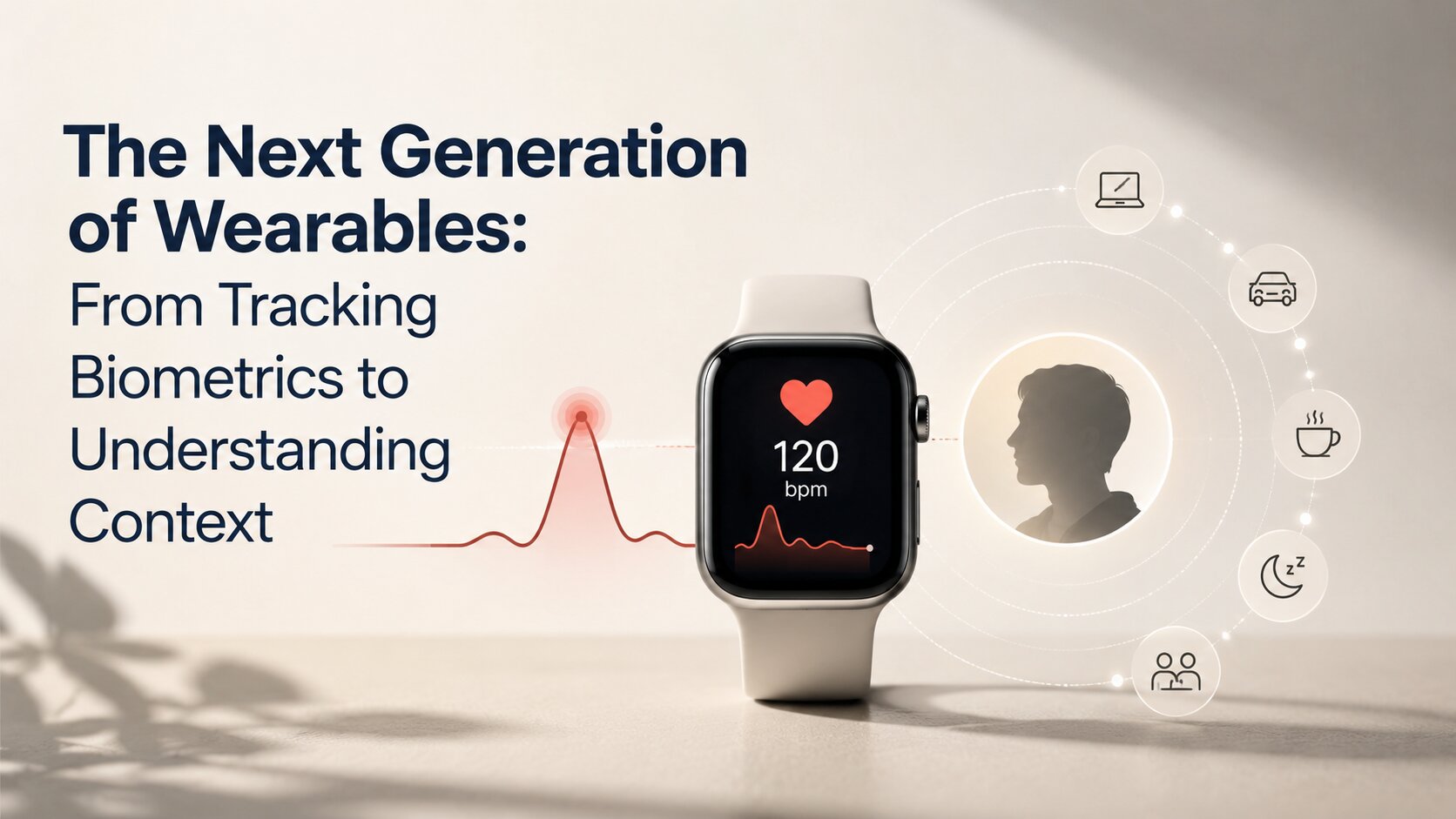
Your smartwatch tells you your heart rate went up. But does it tell you why?
Maybe you were exercising. Maybe you were stuck in traffic. Maybe you slept three hours, skipped lunch, or were walking into an important meeting. The number might be the same in every case. The story behind it is not.
For years, wearable technology has focused on measuring more: heart rate, sleep, steps, calories, oxygen levels, activity. Our bodies have never been more measurable. But there is a problem with more data. Data tells you what happened. Context helps you understand why.
The same heart rate can mean completely different things
Imagine your heart rate rises to 120 beats per minute. At the gym, that might be exactly what you expect. But what if you are sitting at your desk?
It could be a stressful meeting, a difficult conversation, too much caffeine, poor sleep the night before, heat, dehydration, or simply an emotionally intense moment. The wearable sees 120 bpm. You experience a completely different situation.
The details that change the meaning of a reading are rarely on the watch: what you were doing, where you were, how you had slept, whether you had eaten, who you were with, and what happened earlier that day. Without them, a number is just a number.
From "what happened" to "why it happened"
Say you notice your heart rate rises between 9:00 and 10:00 every Monday morning. A traditional wearable shows you the trend. Context reveals something more interesting: maybe that hour is your weekly team meeting, your commute, the coffee you drink before work, or a recurring presentation you find stressful.
Now the data becomes something you can act on. You are no longer looking at a graph. You are starting to see the relationship between your body and your life.
That shift matters because health does not happen in a vacuum. Your physiology is constantly responding to your environment, routines, emotions, activities, and relationships.
The future may be less about more sensors
The instinct in wearable technology has always been to ask: what else can we measure? The next question may be: what can we understand from what we already measure?
Imagine an experience that does not just tell you your heart rate changed, but helps you notice that similar changes tend to appear after short nights, during long meetings, or on days you skip meals. Over time, the picture becomes personal, because it is built from your life, not from population averages.
It also changes the timing. Instead of reviewing a dashboard at the end of the day, you can notice something in the moment. A signal changes. The context is still fresh. And you get an opportunity to pause.
How Pauser approaches this
At Pauser, we build around a simple idea: a heart rate signal means more when you can see the moment around it.
When your heart rate moves outside the range you set, Pauser can send a gentle Pause Signal to your wrist. Right then, while the moment is still fresh, you can tag what is going on in your own words: meeting, commute, coffee, short night. Over time, your tagged moments sit side by side, and the patterns become yours to see.
Pauser does not decide what caused a change, and it does not diagnose anything. It helps you capture the context you would otherwise forget, so the most useful question shifts from "what was my number" to "what tends to surround moments like this for me."
The takeaway
The future of wearables is not just more biometric data. It is a better understanding of the data we already have. The most valuable wearable may not be the one that measures the most. It may be the one that helps you understand yourself.
Find your why. Take a pause.