



If something feels off every time you stand up, you are not imagining it. Here is what to look for, and when it is worth talking to a doctor.
A quick note. This article is here to help you understand POTS, not to diagnose it. Only a doctor can do that. Please talk to a healthcare professional about your own health.
A lot of people live with POTS for years before anyone gives it a name. The symptoms are real and they get in the way of daily life, but because they show up all over the body, they are easy to blame on something else. Stress. Not drinking enough water. Being run down. Just needing more sleep.
That is exactly why so many people go a long time without answers. And it is why learning to recognize the pattern early can genuinely change things. When you know what you are looking at, you can get the right test sooner and start feeling more like yourself.
Let's walk through the signs of POTS, the clues that set it apart from ordinary tiredness, and the point where it makes sense to see a doctor.
In this article
Why Catching It Early Matters
POTS stands for Postural Orthostatic Tachycardia Syndrome. It is a problem with the autonomic nervous system, the part of your body that quietly runs things you never think about, like your heart rate and blood pressure. It is more common than most people realize, and it slips past a lot of doctors.
The research on this is honestly a little heartbreaking. People often bounce between several doctors before anyone figures it out. In one large patient registry, folks had seen an average of five physicians first, and about two out of three had been told their very physical symptoms were down to anxiety.
So why does spotting it early help so much? A few reasons.
It gets you to answers faster. When you know the right questions to ask, you are more likely to get the right test instead of another shrug.
It keeps a bad cycle from taking hold. When you feel awful, you naturally move less, and moving less can make POTS worse over time. Getting a plan in place sooner helps you avoid that slide.
And it quiets the self doubt. There is real relief in learning your symptoms have a physical cause, especially after being told it is all in your head. It never was.
The One Sign That Stands Out Most
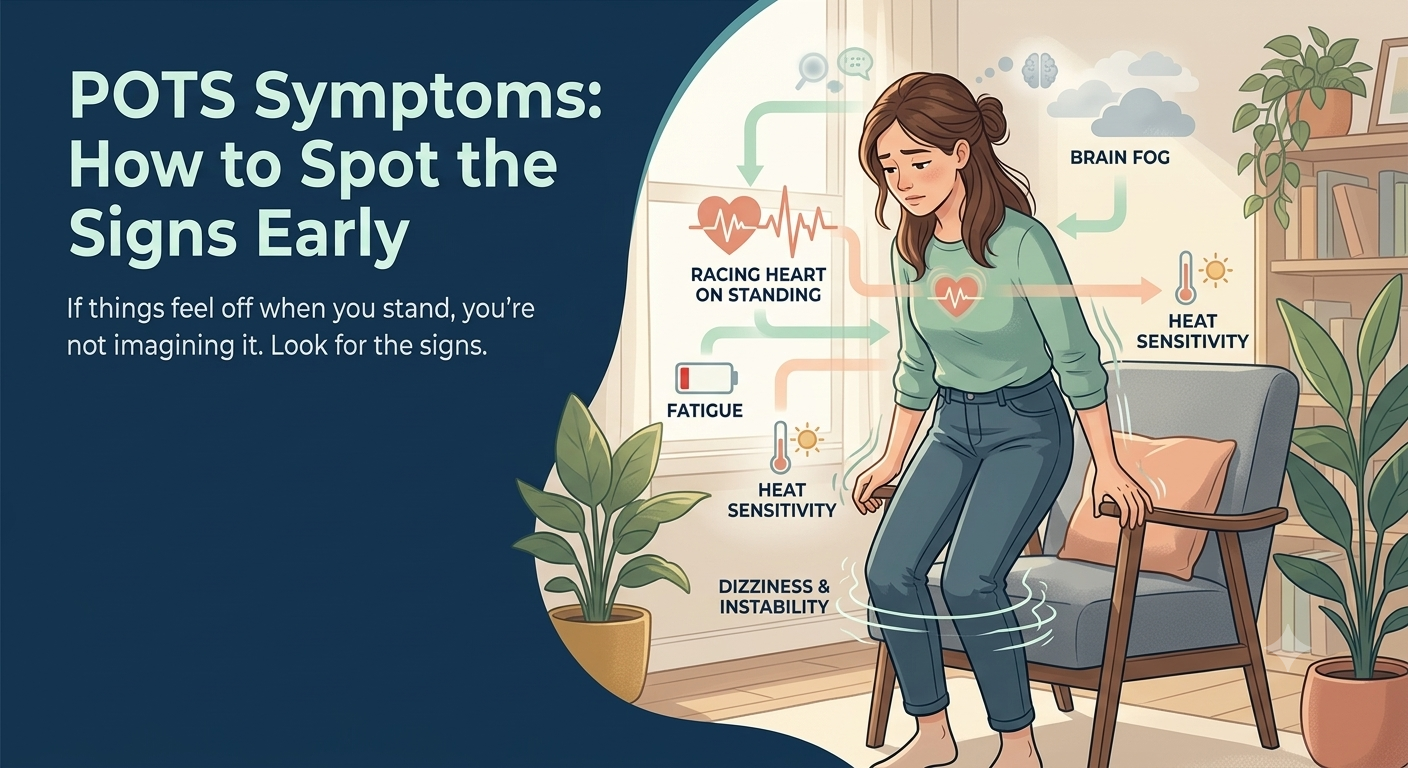
If you remember nothing else, remember this. The signature clue of POTS is a heart that starts racing when you stand up.
When someone with POTS gets to their feet, their heart rate shoots up, often by 30 beats a minute or more within a few minutes, and it stays high the whole time they are upright. Lie back down and it usually calms right down. That pattern, worse standing and better lying flat, sits at the center of the whole condition.
The racing heart often comes with feeling dizzy, wobbly, or like you might pass out when you stand. If that combination keeps happening, it is worth paying attention to.
Common Symptoms to Watch For
POTS is about a lot more than heart rate. Because the nervous system reaches nearly every organ, the symptoms turn up in surprising places. These are the ones people notice most.
Heart and circulation
- A racing or pounding heart, especially on standing
- A fluttering or skipped beat feeling
- Discomfort in the chest
- Feeling lightheaded or dizzy when you get up
- Fainting, or that swimmy feeling right before it
Brain and energy
- Brain fog, so trouble focusing, remembering, or landing on the right word
- Deep fatigue that a good night of sleep does not fix
- Headaches, sometimes an ache across the neck and shoulders
- Blurry vision
- Trouble sleeping
The rest of the body
- Getting wiped out by activity that used to feel easy
- Nausea, bloating, or a touchy stomach
- Shakiness
- A hard time in the heat
- Blood pooling in the legs, which can make them look purple or blotchy when you stand
Nobody has all of these, and how strong they are varies a lot from one person to the next. What matters for spotting POTS is the mix and the timing, not any single symptom on its own.
The Patterns That Give POTS Away
Here is the part that is easy to overlook, and probably the most useful thing on this page. It is not only which symptoms you have. It is when they show up. These patterns are strong hints.
- Worse standing, better lying down. Symptoms flare when you are up and ease when you go flat.
- Rough in the morning. A lot of people feel their worst right after waking.
- Worse in the heat. Hot weather, hot showers, and saunas tend to crank things up.
- Worse after eating. A big meal, or a heavy carb one, can set off dizziness or a racing heart while your body sends blood to digestion.
- Started after something. POTS often begins after a virus, including COVID, or after pregnancy, surgery, or a long stretch stuck in bed.
- Happens again and again. This is not the odd off day. The standing racing heart tends to be reliable, which is part of what makes it recognizable.
If several of these feel familiar, that is a real signal, and a stronger one than any single symptom by itself.
Who Tends to Get POTS
POTS can happen to anyone, but it turns up far more often in some groups. You may be more likely to have it if you:
- Are a woman roughly between 15 and 50. Most people with POTS are young women.
- Started feeling this way after an illness, especially long COVID, which is closely tied to POTS style symptoms.
- Have bendy, hypermobile joints, or a diagnosis of hypermobile Ehlers Danlos syndrome.
- Have mast cell activation syndrome, or strong allergy type reactions.
- Recently went through puberty, pregnancy, surgery, or a serious illness.
Being in one of these groups does not mean you have POTS. It just means your symptoms deserve a proper look instead of being waved off.
When to See a Doctor
It is worth booking a visit if you notice:
- A racing heart or dizziness on standing that keeps happening over weeks or longer
- Symptoms getting in the way of ordinary life, like work, school, exercise, or just getting through the day
- Fainting, or nearly fainting
- A bunch of these symptoms that started after an illness and never fully went away
You do not have to wait until it gets severe. Bringing these things up early, ideally with a few notes about what you have been feeling, is exactly how a lot of people finally get somewhere.
How a Doctor Confirms It
Only a doctor can diagnose POTS, and it comes down to watching how your heart rate reacts to standing. The usual benchmark is a steady rise of 30 beats a minute or more within ten minutes of standing in adults, or 40 or more in teens, without a big drop in blood pressure, with symptoms that have stuck around for at least three months.
This is usually checked with a tilt table test, where a table slowly tips you upright while your heart rate and blood pressure are tracked, or with a simpler standing test done at the bedside. A doctor will also rule out other reasons for a fast heart rate first, like thyroid trouble, low iron, or dehydration.
What to Jot Down Before Your Visit
Because POTS comes and goes, a single appointment does not always capture what is really going on. Walking in with a simple record can make a big difference, and it is a lot harder to brush aside than a vague description. A few things worth noting:
- Your heart rate lying down and then after standing, if you have a wearable or can find your pulse
- When the symptoms hit, so the time of day and what you were up to
- What seems to set them off, like heat, meals, standing a while, poor sleep, or your cycle
- How much all of it is affecting your daily life
Patterns that are invisible from one day to the next often become obvious over a couple of weeks. That record helps your doctor connect the dots faster, and it helps you walk in feeling sure of what you want to say.
Common Questions
How long does it usually take to get diagnosed with POTS?
Longer than it should, honestly. Plenty of people see several doctors over months or even years, partly because the symptoms look so much like other things. Knowing the pattern and bringing notes to your appointment can help move it along.
Can POTS be caught early?
Yes. There is no way to prevent it, but the sooner you recognize the pattern, the sooner you can get tested and start feeling better. You do not need any fancy equipment, just an awareness of the signs and a chat with your doctor.
Does a racing heart when standing always mean POTS?
No. A small bump in heart rate when you stand is completely normal, and other things can speed your heart up too, like dehydration, low iron, thyroid issues, some medications, or anxiety. POTS is the specific version where the jump is large, stays up while you are on your feet, and settles when you lie down. That is why a doctor needs to sort it out.
Can I check for POTS at home?
You can notice patterns at home, like how your heart rate compares lying down versus standing, and when your symptoms tend to strike. That is genuinely useful to bring to a doctor. But noticing a pattern is not the same as a diagnosis. POTS still needs to be confirmed by a professional.
Is POTS serious?
For most people it is not life threatening, though it can be seriously limiting and really affect quality of life. The encouraging part is that it is very manageable for a lot of people once it is named and there is a plan in place. That is the whole reason spotting it early is worth the effort.
One Last Thing
If the patterns here sound like your life, take them seriously. You are not overreacting, and you are not making it up. POTS is a real, recognized condition, and noticing the signs is the first real step toward getting proper care.
You do not have to have it all figured out today. Write down what you are feeling, pay attention to when it happens, and bring it to a doctor. That small act has helped a lot of people finally get the answers they had been chasing for years.
Spot your patterns with Pauser
POTS is a pattern problem, and patterns are hard to see in the moment. Pauser helps you connect your wearable data, like heart rate and sleep, with what is actually going on in your day, so the signs behind your symptoms get easier to notice over time.
Explore Pauser Subscribe to our newsletter
Pauser is not a medical device and does not diagnose, treat, or cure any condition. Always talk to a qualified healthcare professional about your health.
Sources and Further Reading
- Dysautonomia International, Postural Orthostatic Tachycardia Syndrome
- Cleveland Clinic, Dysautonomia
- Johns Hopkins Medicine, Postural Orthostatic Tachycardia Syndrome (POTS)
- Australian POTS Patient Registry, symptom burden and diagnostic journey
Tags: POTS